
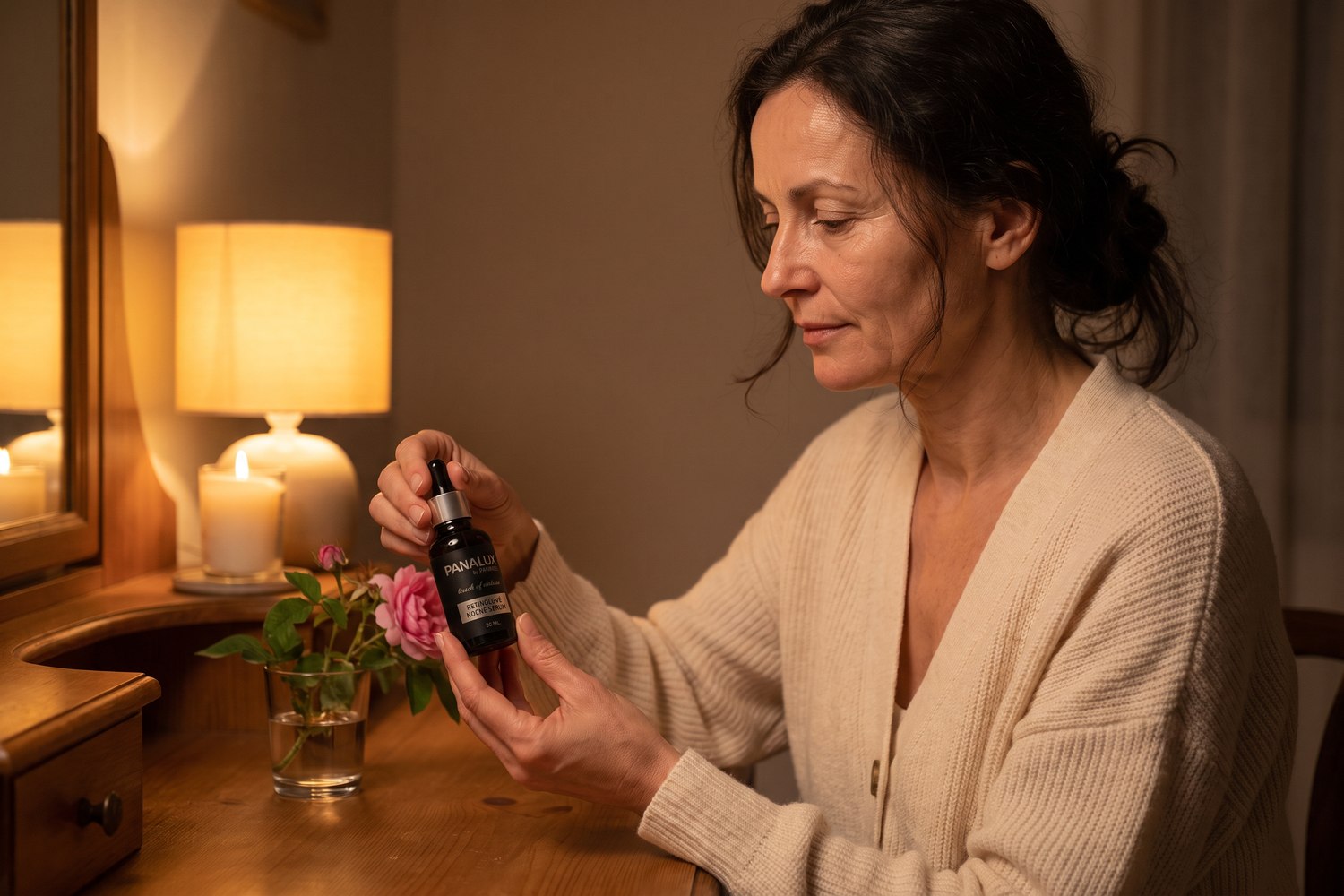
A retinol serum is skincare with a retinoid, that is, an ingredient derived from vitamin A, which is usually used in the evening. If you are curious how it looks in practice, take a look at the Retinol night serum 30 ml in the luxury face serums category. If you are not sure what suits your skin, the Advisor will help.
What is retinol and how does it differ from other retinoids?
Retinol is one of the forms of vitamin A. The skin gradually converts it into further forms, up to the most active one, which is why in cosmetics it is mentioned mainly in connection with more mature skin. The word retinoid is a broader term: it includes retinol, its esters, retinal and other derived compounds. Each has a different name in the composition and differs in how close it is to the active form. That is why one retinol serum can be milder and another more pronounced, even though the same word appears on the package. When choosing, it does not pay to rely on the big lettering on the box; it is far more useful to read the list of ingredients (INCI). The active form, retinoic acid, is used in the European Union as a prescription medicine, not as ordinary cosmetics.
In the Panakeia Retinol night serum the retinoid ingredient is Sodium Retinoyl Hyaluronate, a retinoid bound to hyaluronic acid. It is not classic retinol, which is why we speak here of a retinoid. Besides it the serum contains oat oil (Avena Sativa Kernel Oil), argan oil (Argania Spinosa Kernel Oil), squalane, echium oil (Echium Plantagineum Seed Oil), jojoba oil (Simmondsia Chinensis Seed Oil) and rose water (Rosa Damascena Flower Water). They are complemented by glycogen, frankincense extract (Boswellia Serrata Resin Extract) and carrot root extract (Daucus Carota Root Extract). Check the composition on the product page itself before buying, because it may change.
| Ingredient in the INCI | What it is | What to look at |
|---|---|---|
| Retinol | The basic form of vitamin A | The skin has to convert it |
| Retinyl Palmitate | An ester of retinol with a fatty acid | Considered a milder choice |
| Retinal (Retinaldehyde) | A form closer to the active one | Tends to be more pronounced than retinol |
| Sodium Retinoyl Hyaluronate | A retinoid bound to hyaluronic acid | It is not classic retinol |
How to fit a retinol serum into an evening routine?
Retinoids are usually used in the evening, on clean, dry skin. The order of steps is simple: first gentle cleansing, then toner, serum and finally a cream that softens the skin. Frequency and amount are set by the product label, because there is no universal schedule that would suit every woman. At the beginning choose a calm pace and watch how your skin reacts. If your skin is more sensitive, give it calm hydration alongside the serum and try new products one at a time, so you know what suits you and what does not. More does not mean better. Skin has its own rhythm, and what suits it best is a patient, regular ritual, not sudden experiments. If you treat yourself to an evening slowing down, your skin will repay you with a calm, even look.
- Gently cleanse your skin and let it dry completely.
- Apply a small amount of serum according to the instructions on the label.
- Let it absorb and then add a cream.
- Leave out the area around the eyes and the corners of the mouth, unless the label says otherwise.
- In the morning care for your skin gently and think of sun protection.
How to combine a retinol serum with the rest of your routine?
When combining ingredients it pays to be careful. Many women do not apply a retinoid on the same evening as an acid-based peel but alternate the ingredients from evening to evening, so as not to burden the skin all at once. Every active ingredient occupies the skin a little, and several actives at once can cause a feeling of tightness. The question of how retinol goes with vitamin C appears often in searches. The answer is usually to split the day: vitamin C in the morning and a retinoid in the evening. You can read more about which ingredients are not worth combining in a routine in the article the art of layering cosmetics. If marked redness or burning appears after application, stop using it and consult a doctor or pharmacist, who will assess your particular situation.

Retinol serum and the sun: what to notice
It is said that retinol is dangerous in summer, but the truth is subtler. Retinoids can make skin more sensitive, which is why they are used in the evening and during the day it is good to think of protecting your skin from the sun. Some women take a break in summer, others continue according to the instructions on the label, and the decision depends on skin type as well as the manufacturer’s recommendations. A separate article goes through all the arguments, is retinol really dangerous in summer, and will help you decide. There is no single truth for everyone, so follow the label and your own feeling on the skin. Calm and attention are more valuable here than trying to do everything at once; your skin will show it in its look.
Retinol or bakuchiol: what is the difference?
Bakuchiol is a plant ingredient obtained from the seeds of the plant Psoralea corylifolia and is often mentioned as an alternative to retinol. It is, however, a different molecule with a different structure; it is not a retinoid and it makes no sense to call it natural retinol. Both ingredients appear in similar routines in cosmetics, but they are not interchangeable and they are not equal. Choose a retinol serum and a bakuchiol serum according to what suits you, not by the words on the package. You can find more about bakuchiol in the article bakuchiol and its place in skincare. If you want to turn to scientific literature on retinoids, you will find studies on retinoids in skincare in the PubMed database.
Did you know…
Retinol is a form of vitamin A that the skin gradually converts into further, more active forms, which is why with retinoids it is important to read the composition and not just the name on the package.