
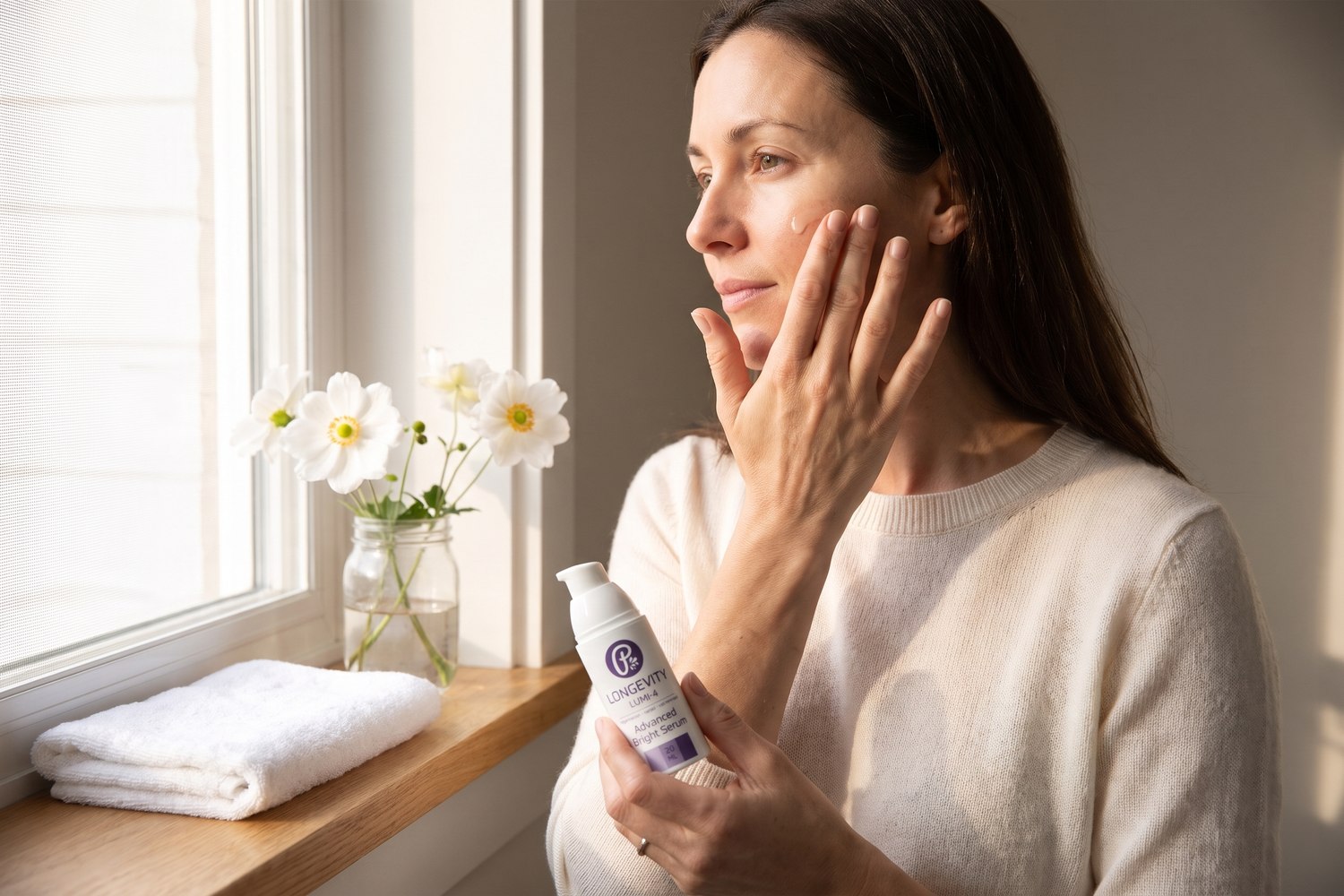
Tranexamic acid is a facial skincare ingredient derived from an amino acid, and in the composition you will find it as Tranexamic Acid. In cosmetics it is about caring for the look of skin tone, not a medicine. You will find it in the LONGEVITY LUMI-4 Advanced Bright Serum in the face serums category, and if you are not sure about your choice, the Advisor on the website will help you.
What tranexamic acid is in skincare and what not to look for in this text
Tranexamic acid is a chemical compound derived from an amino acid. In the composition of cosmetics you will find it under the Latin spelling Tranexamic Acid. We also have a short entry in the glossary, while this text is more practical: how to find it in a serum, how to fit it into a morning routine and what not to expect from it. We are not talking about medicines or tablets here. If you searched for this term because you are looking for a medicine or information about tablets, turn to a doctor or pharmacist and read the patient information leaflet. This is solely about a serum ingredient that is applied to the skin and about how to read it on the label. Cosmetics do not replace an examination. If you notice a mark on your skin that seems unusual to you, show it to a doctor.
What does the label of the LUMI-4 serum say about tranexamic acid?
For now, LUMI-4 is the only product in the online shop that contains it. According to the product page, it is a morning serum with four percent tranexamic acid, which the manufacturer describes as a serum for brighter, more even-looking skin and says it helps lighten the look of pigment spots. It is a light milky emulsion in an airless bottle with a pump, 30 ml, with no added fragrance, with a pH of 6.5. It is intended for the face, neck and décolletage, avoiding the eye area. Before first use, the label advises trying it on a small area of skin and using sun protection during the day. This is important information: the manufacturer itself writes that the serum makes no sense without sun protection, because the spots come back. If you do not like using sun protection, this is not the serum for you.
Where does it sit in the composition and what surrounds it?
In the INCI, LUMI-4 has thirty items and tranexamic acid is in fifth place. Ahead of it there is only water, Bifida Ferment Lysate, propanediol and Sodium Ascorbyl Phosphate, one of the two forms of vitamin C. This is no coincidence. The INCI is written from the highest content down, so at the stated four percent it is no surprise that it stands so high. For items below one percent the order no longer has to follow content, so take the further places in the table as a guide. The page states that the serum has no added fragrance, and that is exactly why it is worth reading the whole INCI to the end, not just the first ten lines.
| Ingredient according to the page | INCI spelling | Position in the composition of 30 |
|---|---|---|
| Vitamin C, water-soluble form | Sodium Ascorbyl Phosphate | 4th |
| Tranexamic acid | Tranexamic Acid | 5th |
| Niacinamide | Niacinamide | 7th |
| Vitamin C, oil-soluble form | Tetrahexyldecyl Ascorbate | 8th |
| Bakuchiol | Bakuchiol | 15th |
| Liquorice extract | Glycyrrhiza Glabra Root Extract | 19th |

How to fit tranexamic acid into your morning routine
The product page describes three steps for the morning. Try going through them at a calm pace, by the window or at the mirror in good light, without rushing off anywhere. The difference between a three-minute routine and a three-minute rush is not in the time, but in how much attention you have left for your own skin while applying. With the toner, notice how your skin feels after washing, with the serum do not stop at the first drop, and with the cream pause for a moment. The serum is meant for the morning, so do not apply it in the evening and leave it where the manufacturer intended. This way the whole routine fits into a calm five minutes.
- Wash your face and apply the Cellular Milky Toner-Essence.
- Apply a few drops of serum and gently press it into your skin.
- Continue with your day cream and finish with sun protection.
In the evening, according to the page, reach for another serum from the edition, for example the Cellular Spicule Serum or the Cellular Face Serum. The page does not list substances with which LUMI-4 should not be combined, so the rule from every new routine applies: add only one new product at a time and give your skin time so that you can see how it takes it. A few days of observation will tell you more than any list of rules. If you are curious how vitamin C behaves in other serums, have a look at the article Vitamin C serum, where a similar logic of morning placement applies as with LUMI-4. With sensitive skin, go even more slowly and try the serum first on a small area of skin.
What can you expect from the serum and when is it better to see a doctor?
The manufacturer writes on the page that after the first use the skin feels hydrated and soft, and that the serum absorbs without a greasy film. After a few days it may look more radiant and rested, and for darker spots it counts on several weeks of regular use, specifically six to eight. Every skin is different, so take the numbers as a guide, not a promise. It is also important to know what cosmetics do not do. If a spot is new, growing, changing colour or shape, itching or bleeding, do not leave it to a serum and make an appointment with a doctor or dermatologist. You can find more on why darker areas appear in the article Pigment spots. If you are interested in the professional literature, have a look at studies on tranexamic acid in skin care (source: the PubMed database).
Did you know…
Did you know that in the composition of cosmetics tranexamic acid is written as Tranexamic Acid and that in the LUMI-4 serum it stands in fifth place out of thirty ingredients?